
👋 START HERE
This is your practical Dublin guide, built by a local and designed to be used while you’re actually in the city.
It’s here to answer the questions that usually come up before you arrive and to guide you while you’re in Dublin.
You can keep this guide on your phone and use it to find:
- How to get around Dublin easily
- What’s worth booking ahead and what isn’t
- Locations for top tourist attractions and useful spots
- Common first-time visitor mistakes to avoid
- Practical information you won’t find in generic Dublin travel guides
This guide is designed to be used alongside your trip, not read from start to finish.
Main Menu

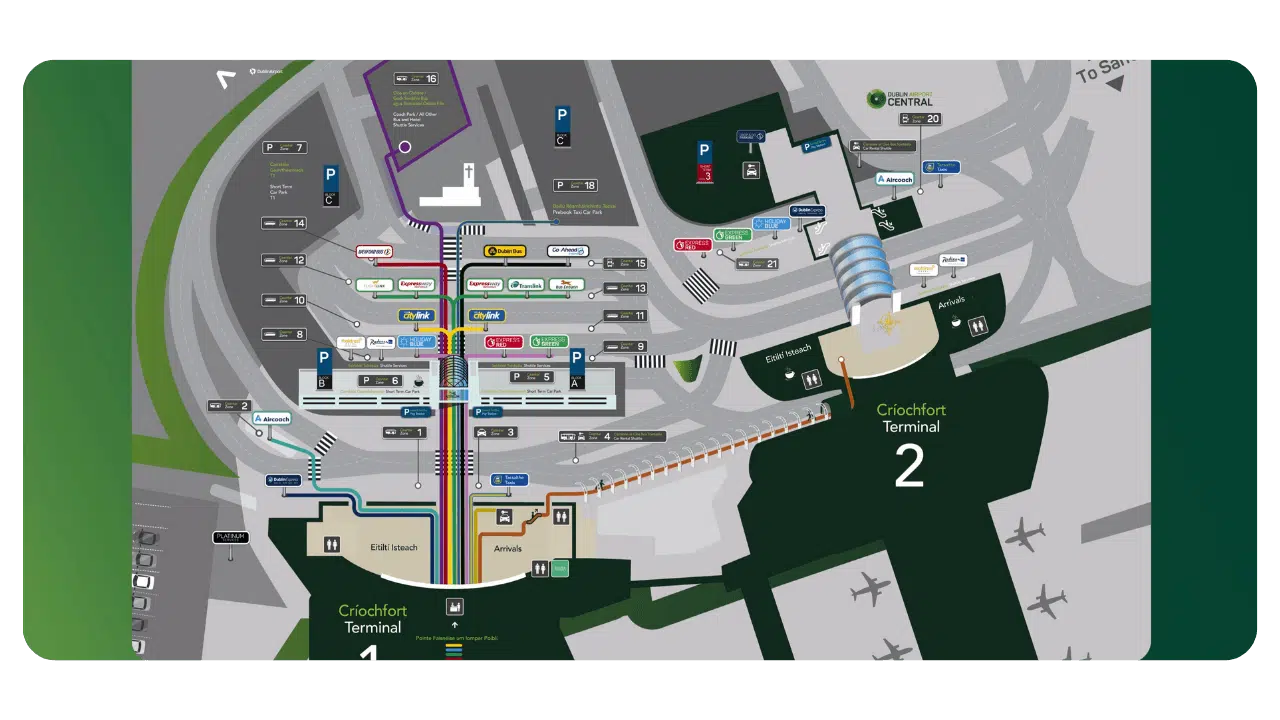
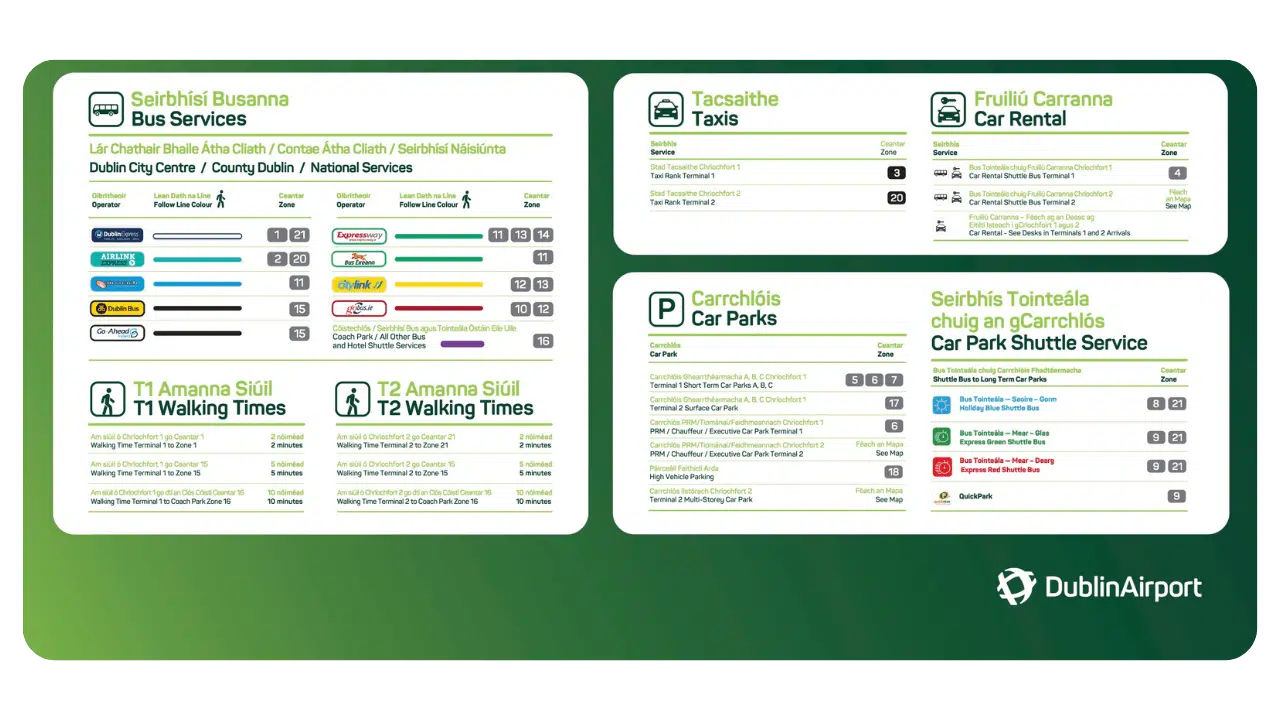
✈️ ARRIVING AT DUBLIN DUBLIN AIRPORT
Dublin Airport has two terminals, both within walking distance of each other. Once you exit arrivals, all transport options are clearly signposted (all locations visable on the above map & within the map section of this app).
There are four main ways to get into Dublin city centre:
🤝 Pre-Booked Airport Pickup: Get collected from the arrivals area and brought directly to your accommodation. I reccomend checking out Welcome Pickups for this, everything is arranged in advance, pricing is clear, and it’s ideal if you’re arriving after a long flight or travelling with luggage.
🚌 Coach Transfers: There are 2 services available, the Dublin Express and Aircoach. Both Services operate in similar ways stopping off at various locations across Dublin City. The one you choose will depend on the location of your accommodation.
🚖 Taxi / Ride Apps: You can either hop into a taxi using the taxi ranks outside both terminals, or use apps like FREE NOW (Android/iOS) or Uber (iOS/Android) to order a taxi on your mobile device (you’ll need to walk outside to Zone 18 to meet your driver).
🚌 Public Transport: You can get public transport from Dublin Airport into the city centre using the 14 and 44 bus routes. However, It’s important to note that they don’t take notes, and you’ll need a Leap Card or exact coins to pay. This is the most affordable option, but it’s the least straightforward.
You can buy a physical SIM card from Irish providers such as Vodafone, Three, or Eir once you’re in Dublin but you’ll need to remove your home SIM and you won’t have service until you arrive and activate it. Personally, I don’t reccomend using this option.
Instead, I recommend using an eSIM. I like Airalo, as it works across all major Irish networks. You can pre-activate it before you arrive in Ireland, and keep your home SIM card installed on your phone. It’s affordable and reliable, and you don’t need to stop into a physical shop to activate it.
Use code IRELAND10 at checkout for 10% off your Airalo eSIM. If you plan to visit Northern Ireland, make sure you choose a plan (like this) that covers both the Republic of Ireland and Northern Ireland.
Main Menu

🚶 Getting Around Dublin
Dublin is a compact city, and you’ll likely end up walking more than you expect. For anything further out, public transport and taxis make it easy to get around.
There are four main ways to get around Dublin:
🚊 The LUAS (Tram): The easiest and most straightforward option. It runs through the city and connects a lot of the main areas you’ll visit.
🚆 DART (Coastal Train): Runs along the coast and is the best option for places like Howth, Dún Laoghaire, and Bray. You can pay using a Leap Card, card, or buy a ticket at the station.
🚌 Buses: Cover most of the city and go places the Luas and DART don’t. You’ll need a Leap Card or exact coins to use them.
🚖 Taxis: Great for direct trips, late nights, or when you just want something easy. You can use taxi ranks around the city or apps like FREE NOW (Android/iOS) and Uber (iOS/Android).
The Leap Card is Ireland’s contactless travel card, and it’s how most locals pay for public transport.
You’ll need one because you can’t tap a debit or credit card on buses, and they only accept a Leap Card or exact coins. On top of that, fares are cheaper when you use a Leap Card, so it’s worth having.
It works across all main transport in Dublin, including buses, the Luas, and the DART, so you won’t need separate tickets.
There are two types of LEAP card you’ll see mentioned:
- Visitor LEAP Card – best value if you’ll be using public transport frequently over a short period
- Standard LEAP Card – better if you’ll be travelling less often or mixing transport with walking
Which one makes sense depends on how much you plan to use public transport during your trip.
LEAP cards can sometimes be purchased at airport newsagents or local shops, but availability isn’t guaranteed, so preordering one is often the easiest option.
You can top up your LEAP card using the app (iOS/Android). You can also use terminals in Luas and DART stations, or top up at some newsagents.
🚖 Taxis: Traffic can increase fares quite a bit, especially at peak times. Taxis are all licensed and metered, there are no rideshare services in Ireland. You can use apps like FREE NOW (Android/iOS) or Uber(iOS/Android), but they still dispatch licensed taxis. Card payment is standard, and if a driver asks for cash only, you can refuse.
🚌 Buses: You need to hail Dublin buses by putting your hand out, otherwise they may not stop. Buses only accept a Leap Card or exact coins (no notes, no change).
🚊 Trains & Trams (Luas + DART): The easiest transport to use. Just tap on and off with a Leap Card, or buy a ticket at the machine before boarding.
Main Menu

🔐 Key Infomation
You can buy a physical SIM card from Irish providers such as Vodafone, Three, or Eir once you’re in Dublin but you’ll need to remove your home SIM and you won’t have service until you arrive and activate it. Personally, I don’t reccomend using this option.
Instead, I recommend using an eSIM. I like Airalo, as it works across all major Irish networks. You can pre-activate it before you arrive in Ireland, and keep your home SIM card installed on your phone. It’s affordable and reliable, and you don’t need to stop into a physical shop to activate it.
Use code IRELAND10 at checkout for 10% off your Airalo eSIM. If you plan to visit Northern Ireland, make sure you choose a plan (like this) that covers both the Republic of Ireland and Northern Ireland.
Public bathrooms are limited in Dublin and aren’t always obvious. There are very few standalone public toilets, most people use cafés, pubs, museums, galleries, or shopping centres
In this app, restroom locations are shown directly on the map so you can quickly find nearby options when you’re out and about.
Card and contactless payments are widely accepted across Dublin. When paying with a foreign card, always decline currency conversion and pay in euros, as it’s usually far cheaper.
It’s also advisable to use ATMs attached to official banks, as private ATM services tend to charge much higher fees.
ATM and bank locations are shown within the map section of this app, so you can easily find them when needed.
If you arrive early or have time after checking out, luggage storage can be very useful. Storage services are located across the city and are generally priced per bag, per day.
I recommend checking out Radical Storage so you can find a range of different storage locations, depending on where you’re staying and what suits your itinerary. Use the code ‘irelandtravelplanning’ for 5% off.
Tap water in Ireland is safe to drink. You can refill bottles from taps in cafés or restaurants if you ask however, dedicated public refill points are limited.
A handy website is refill.ie, which shows cafés, shops, and locations around Dublin that allow you to refill your water bottle. Use it alongside the map to find refill points while you’re out exploring.
Main Menu

🚨 Emergency and Useful Info
If you feel unwell or something happens during your trip, here’s how to handle it:
A&E (Emergency Department): Go here for anything serious or urgent that needs immediate attention.
Walk-in GP (Doctor): Best for non-emergency issues where you still want to see a doctor.
You don’t need to be registered, just walk in.
💊 Pharmacies (Chemists): Usually the first place to go if you’re feeling unwell. They can help with minor illnesses, recommend treatment, and provide many medications without a prescription.
💡 I’ve pinned emergency departments, GP clinics, and pharmacies on the map so you can quickly find the closest option.
Dublin is generally safe, but it’s worth knowing a few basics.
- Avoid quieter parts of the city late at night if you’re unsure of the area, and keep an eye on your belongings in busy spots. I’d also keep your wits about you around areas like Merchant’s Quay and Talbot Street.
- If you lose documents or need help while travelling, touristsos.ie is a really useful resource for embassy contacts and support.
- Save Google Maps offline before your trip so you can still navigate without service
- Keep a photo of important documents on your phone and carry a small backup amount of cash separately.
📞 Emergency Numbers: If you need emergency assistance in Ireland, call 999 or 112. Both connect you to fire, ambulance, or police services. The police are called An Garda Síochána (usually just “the Guards”), and you’ll see them regularly around the city centre.
Main Menu

🛍 Shops, Supermarkets & Souvenirs Finds
If you need to pick up clothes or basics while you’re in Dublin, there are two main derpartment stores that will sort you out:
Penneys (Primark): Cheapest and easiest for quick essentials
Dunnes Stores: Slightly more expensive, but better quality
If you want to stay stustainable you will come across a range of vintage shops (for hand picked stock) and charity shops (for some golden finds).
💡 I’ve pinned the main department stores, shopping centres, vintage shops, and charity shops on the in app map so you can easily find what’s nearby.
You’ll find supermarkets and small shops all over the city, so it’s easy to grab food on the go.
Supermarkets: Dunnes Stores, Tesco, SuperValu
Convenience stores: Spar, Centra, Circle K
💡 Local Tip: Deli Counters
Most supermarkets and convenience stores have a deli counter where you can order fresh rolls, sandwiches, and hot food.
You choose your fillings, and it’s one of the easiest and cheapest ways to get a decent lunch in Dublin.
You’ll see plenty of souvenir shops around Dublin, and not all of them are bad.
Carrols is very touristy, but it’s useful if you need something quick. You’ll find magnets, postcards, Irish tea, and other recognisable Irish souvenirs.
If you want something more local or meaningful, these are better options:
- Aran Sweater Market for traditional Aran knitwear
- Kilkenny Design Store and Avoca for Irish-designed gifts, jewellery, and homeware
- Smaller Irish design shops for less generic souvenirs
📚 Books & Irish Finds
If you’d prefer something more personal, Dublin has some great independent bookshops like the Secret Bookstore, Gutter Bookshop, and Chapters where you’ll find Irish authors, prints, and local publications.
💍 Make Your Own Claddagh Ring
If you want a souvenir with real meaning, you can also take part in a Claddagh ring workshop.
The Claddagh is a traditional Irish symbol of love, loyalty, and friendship, and making one yourself is a memorable experience rather than just a purchase. This is listed in the app as an experience.
Main Menu

👋 START HERE

CHRIST CHURCH
⭐️ 4.6 stars | ⏰ 1 day | 🎟️ Not required | 💶 From €12
Dublin’s oldest cathedral, with a gorgeous main space and a large underground crypt that’s packed with curiosities. It’s right beside Dublinia, so you can do both back to back without trekking across town. If you like medieval Dublin, this is the one.
💡 Local Tip: Included on the Dublin City Pass.
⭐️ 4.8 stars | ⏰ 50 minutes | 🎟️ Pre-book recommended | 💶 From €15 A guided visit on board a replica famine era ship in the Docklands, focused on what the voyage was like for people leaving Ireland during the famine. It’s short, impactful, and easy to fit into a half day around EPIC. You’ll go above deck and below into the cramped living quarters. 💡 Local Tip: Included on the Dublin City Pass.
Main Menu